Scope: This is general operating guidance. Follow your local health department and adopted code, facility SOP (standard operating procedure), chemical label, and equipment-manufacturer instructions.
Why Commercial Pool Water Testing Matters
Commercial pool water testing provides the measurements operators use to manage disinfectant, pH, water balance, and day-to-day operating conditions. The test result is not merely a number for a log. It is information used to decide whether the water needs attention.
CDC advises public-pool operators to follow applicable local codes, maintain appropriate disinfectant and pH, test regularly, and keep accurate records. Exact requirements vary by jurisdiction.
Testing is one layer of a broader commercial pool monitoring strategy that also covers alerts, records, and remote visibility.
Core Tests
Free chlorine and pH are among the most frequently monitored parameters. Combined chlorine can help operators understand chloramine-related conditions. Total alkalinity helps explain pH stability and water balance. Depending on the facility and jurisdiction, operators may also test calcium hardness, temperature, total dissolved solids, or other parameters.
The testing plan should be driven by the applicable code and the operational needs of the facility.
Manual Reagent Testing
Manual reagent tests are familiar because an operator collects a sample, adds reagent, observes or measures the reaction, and records the result. Depending on the method, this may use a comparator, titration, photometer, or other instrument.
Manual testing also places a person at the pool, which matters because chemistry is only part of safe operation.
Electronic Probes and Sensors
pH and ORP probes can provide frequent readings and are commonly used with automated controllers. Their output can be valuable for control and trend monitoring.
Probe systems also require a maintenance program. Operators need to follow manufacturer instructions for cleaning, calibration, verification, storage, and replacement. A sensor value is only useful if the sensor remains trustworthy.
ORP Testing vs. Chlorine Testing
ORP is not a free-chlorine ppm test. It measures oxidation-reduction potential in millivolts. Chlorine affects ORP, but pH and other water conditions can influence the reading.
For this reason, an operator should not look at an ORP number and assume it directly reports the free chlorine concentration. More on the distinction: ORP vs. free chlorine and does ORP measure free chlorine?
Automatic Reagent Testing
Automatic reagent testing mechanizes a familiar chemical-testing process. A system takes a sample, introduces reagent, measures the reaction, records the result, and repeats the test on a schedule.
This creates a useful middle ground between isolated manual tests and continuous probe signals: scheduled direct chemistry tests that can be recorded automatically. This is the approach described in our guide to automatic pool water testing.
Manual reagent testing
- Person collects sample and runs the test
- Direct chemistry result at that moment
- Also puts trained eyes on the pool and equipment
Electronic probes
- Frequent or continuous sensor readings
- Useful for automated control and trends
- Require cleaning, calibration, verification, and replacement
Automatic reagent testing
- Scheduled direct chemistry tests
- Fresh chemical reaction each cycle
- Results recorded automatically
How Often Should Commercial Pools Be Tested?
There is no single legal answer for every commercial pool in the United States. Requirements are set by state, local, tribal, or territorial authorities.
As general operational guidance, CDC recommends testing disinfectant and pH at least twice per day and hourly during heavy use. The 2024 Model Aquatic Health Code provides model-code language with more specific testing intervals for different feed/control configurations. Operators must follow the rules that actually apply to their facility.
Records and Documentation
Good records help operators see trends, document corrective action, and demonstrate that the operation has a process. Paper logs can work, but digital systems make records easier to search, share, and review remotely.
Automated readings can supplement the record, but a facility should not assume those readings satisfy every required manual-record provision.
Where Automation Fits
Automation is most valuable when it reduces blind spots without creating false confidence. It can add measurements between staff visits, provide alerts, build history, and give managers remote visibility.
It should be integrated into an operating program that still includes physical inspection, required manual tests, equipment maintenance, and trained judgment.
Where Amano Fits
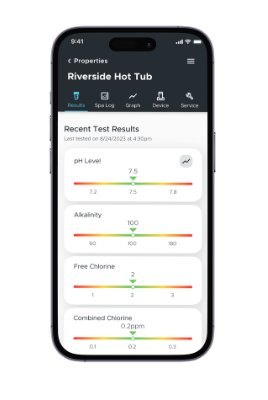
Amano automatically performs scheduled liquid-reagent tests for free chlorine, combined chlorine, pH, and total alkalinity. It sends results over built-in cellular connectivity and stores timestamped chemistry records.
For organizations that already perform required manual tests, Amano is designed to add another set of automated chemistry observations and a shared history between visits.
Add automatic tests between manual checks
See how Amano’s scheduled reagent tests add visibility and a shared chemistry history between required manual tests.
See How Amano Adds Automatic Tests Between Manual Checks Request a Demo
Commercial Pool Water Testing FAQ
What is the most important commercial pool test?
No single test is sufficient. Free chlorine and pH are fundamental, while other parameters provide additional context.
Are ORP and chlorine the same test?
No.
How often must a commercial pool be tested?
Follow the applicable jurisdiction. CDC and the MAHC provide guidance/model language but do not replace local law.
Can automatic testing be added to manual testing?
Yes. That is one practical use of monitoring technology.
Talk through your pools with us
Thirty minutes, your properties, your water-testing setup. No obligation.
Primary sources and scope
Reviewed September 16, 2026. The sources below provide public-health and label context. Amano product details on this page come from current Amano materials.