Scope: This is general operating guidance. Follow your local health department and adopted code, facility SOP (standard operating procedure), chemical label, and equipment-manufacturer instructions.
Commercial Pool Management Is an Information Problem
At one pool, a skilled operator can personally know the equipment, chemistry, and recurring issues. At 20, 50, or 100 pools, that knowledge becomes fragmented across technicians, property staff, paper logs, text messages, vendors, and spreadsheets.
Commercial pool management at scale therefore requires more than chemistry knowledge. It requires a system for collecting information, identifying exceptions, assigning action, and preserving a history. That system is what commercial pool monitoring technology is built to support.
Build a Standard Testing Process
Every property should have a defined testing and inspection process based on the applicable code and operating conditions. Standardization reduces the chance that one site tests carefully while another relies on memory or informal habits.
Define who tests, when tests occur, which parameters are measured (including what different measurements actually mean, such as ORP vs. free chlorine), where results are recorded, what triggers corrective action, and who verifies that the action occurred.
The testing side of that process is covered in our guide to commercial pool water testing.
Separate Required Tasks From Added Visibility
Required manual testing and inspections should be clearly distinguished from optional automated monitoring. That prevents staff from assuming a technology deployment has replaced a legal or operational responsibility.
Automation can then be used for what it does well: adding observations, creating alerts, building history, and giving remote teams visibility. Our guide to automatic pool water testing explains what automated systems can and cannot see.
Manage by Exception
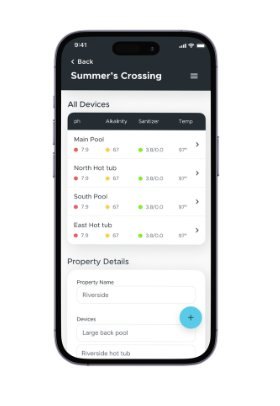
A regional manager should not need to review every normal reading from every pool. The system should surface exceptions: low disinfectant, rising pH, recurring combined chlorine, missing records, or a property that repeatedly requires correction.
This shifts management from “check everything” to “show me what needs attention.”
Create a Single Source of Chemistry History
When records live in multiple binders and phones, pattern recognition becomes difficult. A centralized digital history makes it easier to compare properties, review recurring problems, and answer questions after an incident or inspection.
The goal is not data collection for its own sake. The goal is organizational memory.
Use Trends to Prioritize Maintenance
Repeated chemistry behavior can point to operating issues worth investigating. A pool that repeatedly loses chlorine, a pH value that steadily rises, or a property that constantly needs manual correction deserves attention even if each individual event gets fixed.
Trend data helps distinguish a one-time event from a recurring process problem.
Connectivity Matters at Scale
Every additional installation dependency becomes more expensive across a portfolio. Property Wi-Fi can introduce passwords, network changes, IT approvals, weak signal, or guest-network restrictions.
For some deployments, built-in cellular can simplify the networking side of rollout because the monitoring device does not depend on each property’s Wi-Fi configuration.
Where Amano Fits
Amano is designed for commercial properties and multi-property operations. It performs scheduled reagent tests for free chlorine, combined chlorine, pH, and total alkalinity, sends the readings over built-in cellular, and stores timestamped digital records.
That creates a shared chemistry layer that property staff, regional teams, or service partners can use alongside required manual testing and physical inspection.
One chemistry layer for every property
See how Amano gives property staff, regional teams, and service partners shared chemistry visibility across a portfolio.
A Practical Operating Model
A scalable operating model has four layers: required manual testing and inspection; automated observations between visits; alerts for exceptions; and a shared record of what happened and what was done.
- Required manual testing and inspection
- Automated observations between visits
- Alerts for exceptions
- Shared record of what happened
When those layers work together, management can focus attention on pools that need it without losing sight of the basic responsibilities at every property.
Commercial Pool Management FAQ
What makes multi-property pool management difficult?
Distributed staff, inconsistent processes, point-in-time information, and fragmented records.
Can monitoring replace local operating requirements?
No assumption should be made; follow the applicable jurisdiction.
What should a regional manager see?
Exceptions, trends, recent chemistry history, and enough context to know which property needs attention.
Talk through your pools with us
Thirty minutes, your properties, your water-testing setup. No obligation.
Primary sources and scope
Reviewed September 16, 2026. The sources below provide public-health and label context. Amano product details on this page come from current Amano materials.